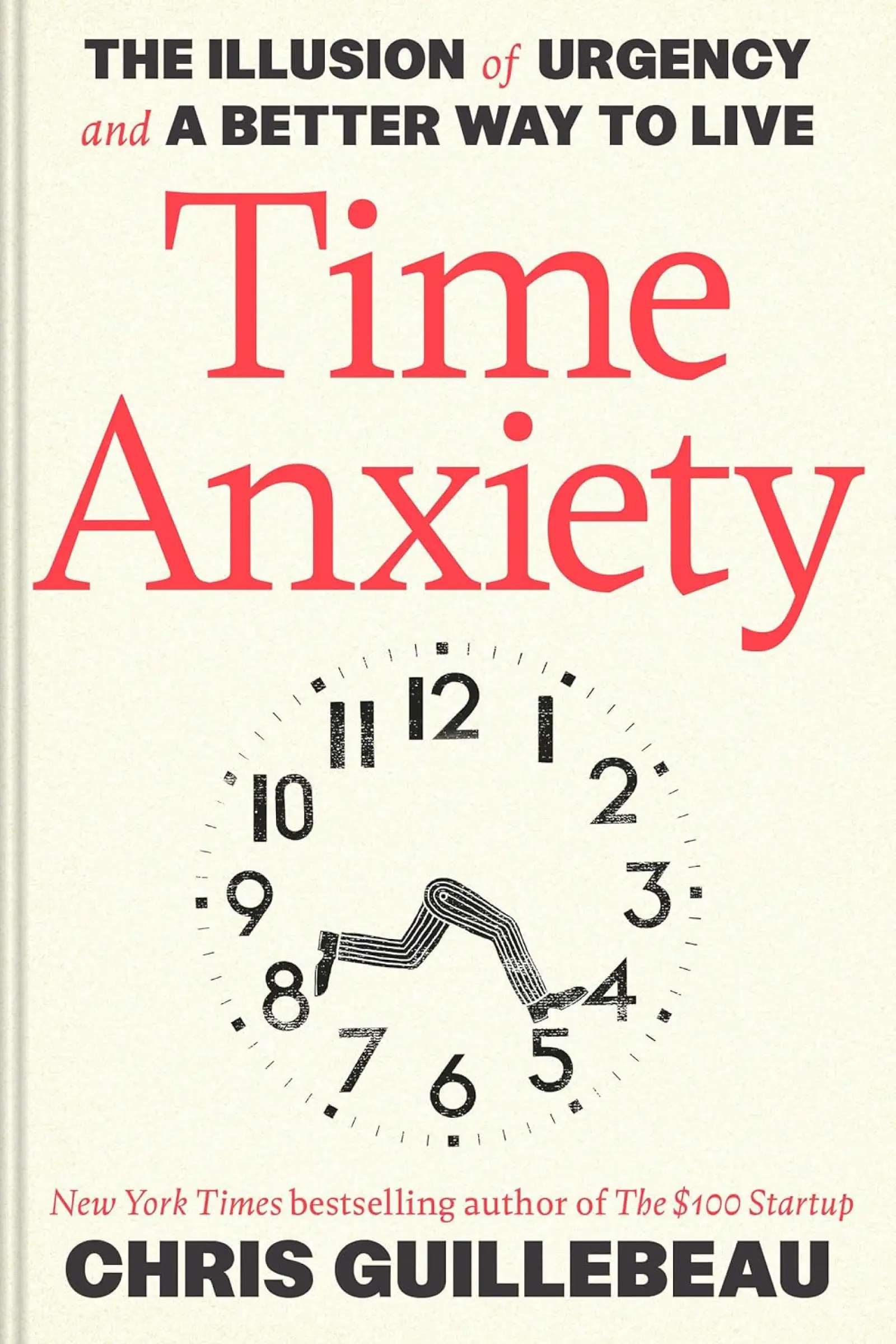
You know the feeling. You're lying awake at 2 a.m. doing math in your head—how many years you have left, whether it's too late to change careers, whether you've already missed your window. Or you're sitting at your desk with seventeen tabs open, a to-do list that keeps growing, and the nagging sense that whatever you're doing right now, it's not the thing you should be doing.
You can't always put your finger on it. Sometimes it's a low hum in the background of an otherwise good day. Other times it hits hard—a wave of dread when you realize another month has gone by, or a jolt of panic when someone your age accomplishes something you haven't.
Most people have felt some version of this. Many feel it every single day. But they don't always have a name for it.
There's a name for it. It's called time anxiety.
Time Anxiety — Definition
Time anxiety is the persistent feeling that time is slipping away and you're not spending it well. It's not a clinical diagnosis. It's the gap between how you're living and how you feel you should be living, filtered through the uncomfortable awareness that your time is finite.
A Name for Something You've Always Felt
Time anxiety is the persistent feeling that time is running out and you're not spending it well. It's not a clinical diagnosis. It's not the same as generalized anxiety, though they can overlap. And it's not FOMO, though it sometimes looks like it from the outside.
It's deeper than that. Time anxiety is really about meaning. It's the gap between how you're spending your time and how you feel you should be spending it—filtered through the uncomfortable awareness that your time is finite. It's the feeling that you're running out of time, that you're falling behind in life, and that some invisible clock is ticking down whether you're ready or not.
When I first wrote about this experience, the responses poured in. People said things like:
"I've always felt this way, but never knew there was a name for it."
"It affects me every single day."
"I honestly believe this is the defining problem of my life."
That last one stopped me. The defining problem of someone's life. And yet most of what gets written about time focuses on managing it better—as if the solution to feeling behind in life is a better calendar app.
It isn't. The problem isn't your schedule. It's your relationship with time itself.
Signs You Might Be Experiencing It
Time anxiety doesn't always announce itself. It often disguises itself as restlessness, indecision, or a vague sense of dissatisfaction. Here are some of the ways it shows up:
- You carry time guilt about how you spent yesterday, last year, the last decade
- You feel pressure to make every moment count, which makes it hard to enjoy any of them
- You worry you're behind in life compared to where you "should" be by now
- Deadline dread follows you everywhere—even self-imposed deadlines feel suffocating
- You can't truly disconnect from work, even during your downtime
- You struggle to make simple decisions because you're afraid of choosing wrong
- You feel an illusion of urgency around things that aren't actually urgent
If several of these feel familiar, the fuller guide to signs of time anxiety can help you identify the pattern without turning it into another diagnosis or label.
If you read that list and thought "that's just life"—that's part of the problem. Time anxiety can become so normal that you stop noticing it. It becomes the water you swim in.
What Time Anxiety Looks Like in Real Life
The symptoms list above is the diagnostic version. Here's what it looks like, day to day.
Time Anxiety vs Related Feelings
Time anxiety overlaps with several other experiences, but it isn't the same as any of them. The distinctions matter, because they each call for different responses.
| Feeling | What it's about | How it differs from time anxiety |
|---|---|---|
| General anxiety | Diffuse worry about many possible threats; a clinical condition. | Time anxiety is specific to time. It's a values experience, not a diagnosis. They can amplify each other. |
| Burnout | Depletion from sustained overwork; loss of motivation and capacity. | Burnout is about being used up. Time anxiety can exist without burnout — the panic that you're not doing enough often shows up at full energy. |
| FOMO | Fear of missing specific experiences other people are having. | FOMO is outward-facing and tied to events. Time anxiety is inward — about the shape of your whole life, not a Saturday night. |
| Existential dread | Acute confrontation with mortality, meaning, or absurdity. | Existential dread is the deep version. Time anxiety is its everyday cousin — same root, smaller dose, harder to recognize. |
| Time guilt | The nagging sense that however you're spending the current moment, it's wrong. | Time guilt is a component of time anxiety, focused on the present. Time anxiety also includes the past (regret) and future (dread). |
The Two Faces of Time Anxiety
As I talked with more people about this, a pattern emerged. Time anxiety tends to show up in one of two ways—and for some of us, both at once.
The first is existential time anxiety. This is the big-picture version. Time is running out in your life. You worry about your purpose, about whether you're on the right path, about what you'll leave behind. It's the 2 a.m. math. It's the dread that comes when you contemplate the finite nature of being alive.
The second is daily time anxiety. This is the day-to-day version. There's not enough time in the day. You're overwhelmed by tasks, paralyzed by too many options, and unable to shake the feeling that you're falling behind. It's the seventeen open tabs. It's starting every email with "Sorry for the delay."
These two forms are connected. When your days feel chaotic, it's hard to think about the bigger picture. And when the bigger picture feels urgent, even small daily decisions carry more weight than they should.
Curious which type shows up most for you?
The Time Anxiety Quiz measures both dimensions and tells you your pattern in about two minutes.
Take the QuizWhy It's Worth Paying Attention To
You can ignore time anxiety. Plenty of people do. You push through, stay busy, tell yourself it's fine—that everyone feels like time is running out. But unexamined time anxiety has a way of making decisions for you. It leads to avoidance—putting off important things because facing them means confronting how much time you've already lost. It leads to overcommitment—saying yes to everything because what if this is the thing that matters? And it leads to a kind of numbness, where you're moving through your days but not really living them.
The alternative isn't to eliminate the feeling. You can't, and you probably shouldn't try. The awareness that time is limited is one of the most powerful forces in human life. The goal isn't to stop feeling it. It's to face it—so it stops running the show from the background.
People who've done this describe something that sounds a lot like relief. Not because anything external changed, but because they finally stopped fighting a truth they already knew: time is limited, but desire is limitless. These facts will always be in conflict. And that's okay.
What Actually Helps
If you're expecting a five-step plan, you might be disappointed. Time anxiety doesn't respond well to productivity hacks—that's like treating a broken leg with a better pair of running shoes.
What does help is a shift in how you think about time. A few starting points:
Notice your time rules. You're living by a set of unwritten rules about how you "should" spend your time—when to wake up, how quickly to respond to emails, what counts as productive. Some of these rules serve you. Many don't. The first step is noticing which are which.
Let things be good enough. Perfectionism and time anxiety feed each other. The belief that everything you do must be excellent is a recipe for paralysis. Sometimes eating at McDonald's is better than not eating. Sometimes a half-finished task is better than a task you never started.
Pay yourself first. In personal finance, "pay yourself first" means setting aside savings before paying bills. Apply the same idea to your time. Instead of deferring the things you actually enjoy until everything else is handled, flip the order. Your best hours shouldn't always go to someone else's priorities.
Face the countdown. Here's the uncomfortable truth underneath all of this: the reason time feels short is because it is. We're all operating on a countdown. That fact can be terrifying—or it can be the most clarifying thing you've ever accepted. Once you know you're going to die, you can stop pretending you have time for things that don't matter to you.
None of this is a quick fix. But it's a different starting point than "get more organized." It starts with your values, not your calendar.
Time anxiety isn't a disorder to fix. It's a signal—one that's trying to tell you something about how you're living and what you actually care about. The question isn't how to make it go away. It's what to do with it once you start listening.